The short answer
The breathing exercise most likely to help you fall asleep is one where the exhale is longer than the inhale, done slowly, lying down, for about five minutes. A common version is inhale for 4 counts, hold for 2, exhale for 6 to 8. Another is the 4-7-8 pattern popularised by Dr Andrew Weil: inhale for 4, hold for 7, exhale for 8. The exact numbers matter less than the shape: short in, long out, no rushing.
That shape is what does the work. A longer exhale nudges your nervous system from the alert, sympathetic state toward the calmer, parasympathetic one. It's the same shift that happens naturally when you sigh. You're not tricking your body into sleep, you're removing one of the things keeping it awake: a breathing pattern that signals it still needs to stay alert.
Why the exhale is the important part
Most people, when told to "breathe deeply," take a big dramatic inhale and stop there. That's backwards for sleep. A big inhale on its own can actually raise heart rate slightly, which is the opposite of what you want at 11pm. The exhale is where the parasympathetic nervous system gets engaged, specifically through the vagus nerve, which runs from your brainstem through your chest and has a direct influence on heart rate. Slow it down and heart rate tends to follow. This is well established in general stress physiology, though I'll say plainly that the research specifically on breathing exercises curing insomnia is thinner than most wellness articles admit. What we can say honestly is that slow, exhale-longer breathing reliably lowers physiological arousal in the short term, and lower arousal is a reasonable precondition for sleep, even if it's not a guarantee.
The mistake almost everyone makes with this
People turn breathing into a performance. They count too precisely, worry they're doing it wrong, get frustrated when their mind wanders on count 3, and end up more alert than when they started. The irony is real: trying hard to relax is a form of trying hard, full stop.
The fix is to treat the numbers as a loose rhythm, not a test. If you lose count, you haven't failed, you've just taken a breath. Also skip the aggressive breath-holding versions if you're prone to anxiety. A 7-count hold before an 8-count exhale can feel like restriction rather than calm for some people, and a racing heart from a held breath is not the goal. If that's you, drop the hold entirely and just do 4 in, 6 or 8 out.
How to actually do it tonight
Lie on your back or your side, hand resting on your stomach if that helps you notice the breath. Close your eyes. Breathe in through your nose for a slow 4 count, letting your stomach rise rather than your chest. Pause briefly, not a strain, just a beat. Then exhale through your mouth or nose for 6 to 8 counts, slower than feels natural at first. Repeat for five to ten rounds. Most people feel a shift by round six or seven, a kind of settling in the shoulders and jaw you can actually feel.
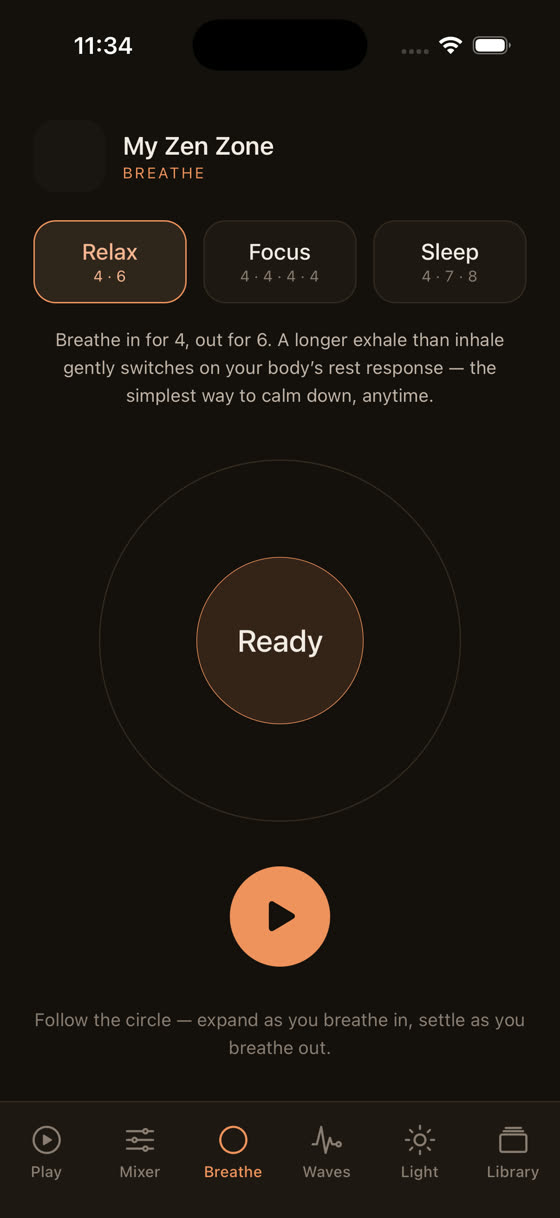
This is easier with something to follow rather than counting in your head, which is its own small cognitive task. A visual pattern that expands and contracts at the right pace does the counting for you, so your mind has one less thing to manage right before sleep.
Pairing breath with sound, deliberately
Tempo matters here more than people realise. Music or ambient sound with a pulse faster than your target breathing rate will subtly pull you back toward it. Something in the 50-60 bpm range, close to a slowed resting heart rate, tends to sit underneath slow breathing without fighting it. This is part of why we compose most of our sleep tracks in that range rather than the 70-90 bpm you'd hear on a typical ambient playlist.
Nature sound layered underneath can help too, not as decoration but as a mask for the small noises that otherwise catch your attention mid-breath; a door settling, traffic outside, a radiator ticking. Being able to set rain quieter than a low drone, with a third layer of something like distant wind barely audible, means the whole bed of sound supports the breathing instead of competing with it.
That's the actual advantage of building your own mix rather than pressing play on someone else's fixed playlist: you can shape the sound around what your ear needs on a given night, not what suited whoever recorded the track. We go into this more in our piece on choosing music for sleep, but the short version is that a single static track rarely suits every night equally.
When breathing exercises won't fix the problem
It's worth being direct about limits. If your mind is racing because of a specific worry, actual problem-solving anxiety, breathing alone won't resolve that; it might calm the body while the thought loops keep going. If you have diagnosed sleep apnea or another breathing-related sleep disorder, slow breathing exercises are not a substitute for medical treatment, and you should talk to a doctor rather than relying on this. And if you've tried breathing exercises for several nights with no shift at all, that's useful information, not a personal failure. It might mean the issue is more about sleep timing, screen exposure, or caffeine than about nervous system arousal at bedtime.
For daytime anxiety or pre-exam nerves specifically, a faster-paced version of similar breathing can help with focus rather than sleep, which is a different use case covered in our piece on music for focus and study.
Making it a repeatable habit, not a one-off trick
Breathing exercises work better as a habit than as an emergency measure you only reach for during a bad night. Doing the same five minutes of slow breathing at roughly the same point in your wind-down routine, every night, teaches your body to associate the pattern with sleep approaching, the same way a familiar scent or a dimmed room does.
Pairing the breathing with a dimming light screen and a sleep timer set to 20 or 30 minutes means you're not reaching for your phone again once you've settled, which defeats half the point of calming down in the first place. The whole sequence, light dimming, breath pattern, a slow track fading under a sleep timer, becomes a single cue rather than three separate decisions you have to make every night.
Where this fits with everything else
Breathing is one piece, not the whole plan. It works best alongside the basics: a consistent bedtime, a dark room, caffeine cut off by early afternoon. On its own it's a reliable, free, five-minute tool with no real downside, which is more than you can say for most sleep aids. If you want to try it properly tonight, pair the pattern above with something slow underneath it rather than silence, which most people find harder to sustain attention on than they expect. You can find the full library, including the slower-tempo sleep tracks and the breathing screen, through the app itself, or start with a download if you haven't already.
Common questions
How long should a breathing exercise take before bed
Five to ten minutes is usually enough to notice a physical shift, slower heart rate, looser shoulders. Longer isn't necessarily better; if you're still wide awake after fifteen minutes of breathing, the issue is probably something other than nervous system arousal, like a racing mind over a specific worry.
Is 4-7-8 breathing better than box breathing for sleep
For sleep specifically, 4-7-8 or any exhale-longer pattern tends to work better than box breathing, which uses equal counts for inhale, hold, and exhale. Box breathing is more often used for focus and composure during the day. For winding down at night, you want the exhale noticeably longer than the inhale, not matched.
Can breathing exercises replace sleep medication
No, and you shouldn't treat them that way. Breathing exercises can lower physical arousal before bed, which helps some people fall asleep faster, but they're not a treatment for insomnia disorders or sleep apnea. If sleep problems are persistent, speak with a doctor rather than relying on breathing alone.
Why do I feel dizzy when I do slow breathing exercises
Dizziness usually means you're breathing too deeply or holding too long relative to what's comfortable. Shorten the hold, or drop it entirely, and keep the inhale gentle rather than maximal. If dizziness continues even with lighter breathing, stop and breathe normally; it's not necessary to push through it.