The short answer: steady, low-pitched, unchanging sound works better than almost anything melodic. Brown noise, rain, ocean swell, and a droning fan all share the same trick — they cover up the sharp little noises that keep waking you, and they never surprise you. Pick something with no story, no build, and no ending, and you're most of the way there.
Why noise works better than silence
Silence sounds like the goal, but a genuinely silent room rarely exists and your brain is wired to notice the gaps in it. A door settling, a car outside, a partner turning over — in true quiet, each one lands like an event. A steady background sound raises the floor so those small spikes stop registering as anything worth waking up for. This is called masking, and it's the entire reason white noise machines caught on decades before anyone had a word for it. You're not trying to relax to the noise. You're trying to make everything else boring by comparison.
The three you'll actually recognise: white, pink and brown noise
White noise has equal energy across every frequency, which in practice sounds thin and hissy, closer to static than most people enjoy for eight hours. Pink noise drops the higher frequencies a little, so it sounds fuller, more like steady rainfall or wind — most listeners find it easier to sit with for a long stretch. Brown noise goes further still, all low end, closer to distant thunder or a jet engine heard through a wall. There's no rule that says one is medically better than another; the honest answer is that the research on noise colour and sleep quality is thin and mostly small-scale, so this comes down to what your ears tolerate at 2am, not a formula. Most people land on pink or brown because white noise's hiss sits right in the frequency range that irritates rather than soothes.
Nature sounds and why rain beats a fan for most people
Recorded nature sound works on the same masking principle but adds a layer that a machine hum doesn't have: it feels lived-in rather than mechanical. Rain, in particular, has natural irregularity — heavier gusts, lighter patches — that somehow reads as calming rather than distracting, probably because the brain doesn't expect it to mean anything. Ocean waves work the same way, provided the rhythm is slow and the waves aren't too far apart, which starts to sound like breathing instead of background. A campfire crackle sits somewhere between the two: mostly steady, with occasional pops that some sleepers find grounding and others find intrusive. There's no universal winner here, which is exactly why a single fixed nature-sounds track is a weaker tool than being able to combine a few at your own levels.
That clip shows the actual mechanism: three nature layers, each with its own slider, being nudged up and down live. Rain low, distant thunder lower still, a thread of wind on top. That's a genuinely different experience from hitting play on someone else's fixed rain-sounds track and hoping the balance suits you.
The mistake most sleep-sound articles make
Most lists like this one recommend a sound and stop there, as if the sound alone did the work. What they miss is that almost any calming noise fails if it changes too much over time. A track with a swelling string section, a key change, or a big dynamic drop two minutes before the end will pull a light sleeper straight out of drowsiness, even at low volume, because change itself is what the ear is built to notice. This is also why some music marketed as "relaxing" is actually a poor choice for sleep — it was composed to be listened to, with arcs and resolutions, rather than composed to be ignored. Good sleep material is closer to wallpaper than to a song. If you want a longer look at what separates the two, this piece on music for sleep goes into the compositional side of it.
Volume, tempo and the numbers that matter
Loudness matters more than most people admit. The masking effect works at a surprisingly low volume — quieter than a normal conversation, closer to the hum of a fridge in another room. Louder than that and the sound itself becomes the thing keeping you awake. If there's music involved rather than pure noise or nature sound, tempo matters just as much: something around 50 to 65 beats per minute, roughly a resting heart rate, tends to sit underneath sleep rather than compete with it. Anything faster starts to feel like it's nudging you along, even instrumentally, which is fine for a work playlist and wrong for a bedroom.
Build your own instead of picking one track
The honest limitation of a single downloaded sleep track, whatever it is, is that someone else decided the balance for you. Maybe the rain is too loud in their mix, or there's a bird call every ninety seconds that grates on you specifically. The fix is simple in theory and almost nobody offers it: let the listener set the levels. That's the whole idea behind the mixer in My Zen Zone — rain, wind, distant thunder, low tones, each on its own slider, so you're not stuck with someone else's proportions.
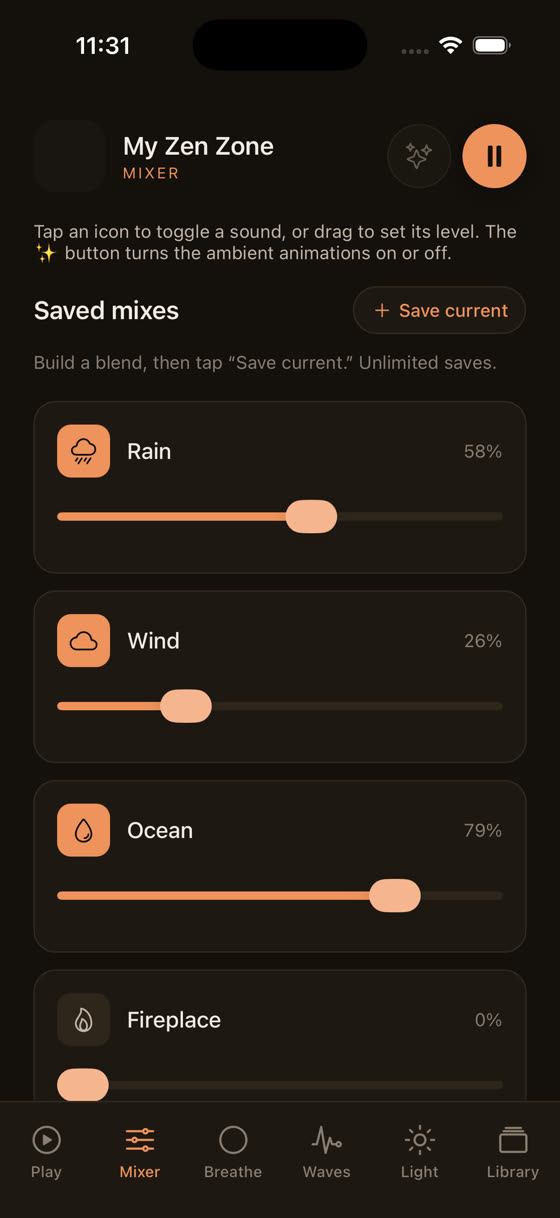
Once you've found a combination that works, save it, set a sleep timer so it fades out rather than looping all night, and download it for offline use so a patchy connection at 1am doesn't cut the sound out mid-cycle. It's a small set of controls, but it's the difference between a track you tolerate and one you actually reach for every night.
Make it a habit, not a one-off
Sound helps most when it's consistent, not when it's novel. The same rain mix, night after night, starts to work as a cue — your body learns that this sound means it's time to wind down, in the same way a bedtime routine does. That's worth knowing before you go hunting for a different "best" sleep sound every week; the searching itself can undo the benefit. If your mind is still busy rather than just noisy — running through tomorrow's list rather than reacting to creaks — pairing the sound with a slower breath pattern can help more than the sound alone.
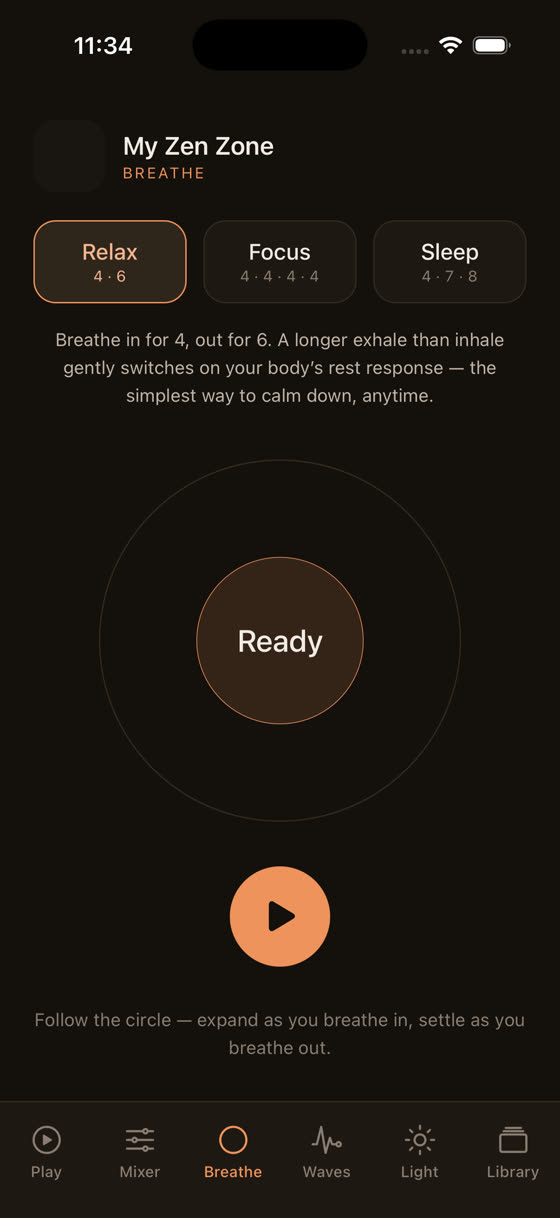
A short 4-6 breathing pattern before you press play gives your body somewhere to land before the sound has to do all the work by itself.
What to try tonight
Start with brown or pink noise if you've never used sound to sleep before — it's the least likely to grate. If you already know you like nature sound, build a simple two-layer mix rather than a busy one: rain plus one low tone, nothing more, at a volume you'd describe as background rather than foreground. Give it a full week before switching, because the habituation effect takes a few nights to kick in properly. And if what you actually need during the day is the opposite problem — staying alert rather than falling asleep — the mechanics are different enough that it's worth a separate look at what works for focus instead of assuming the same sound serves both. You can try the mixer and the full sound library free by starting here, or see the whole thing laid out at myzenzone.app.
Common questions
Is white noise bad for you if you listen every night?
There's no solid evidence that nightly white or pink noise causes harm at a sensible volume. The main practical concern is dependency — some people find they sleep poorly without it while travelling. Keep the volume conversational or lower and it's a reasonable long-term habit, not something you need to wean off unless it's genuinely bothering you.
What's better for sleep, rain sounds or a fan?
Neither is objectively superior; it's about which one your ear tolerates for hours without noticing it. A fan gives pure mechanical masking with zero variation. Rain adds gentle, meaningless irregularity that many people find more soothing than a flat hum. Try both for a few nights each rather than assuming one is the correct answer.
Should I use headphones or a speaker for sleep sounds?
A speaker across the room is generally the safer default, since headphones can press uncomfortably once you're lying on your side and there's no independent evidence that in-ear listening improves sleep sound's effect. If you do use headphones, choose soft over-ear ones and keep the volume low.
Can sound actually help with jet lag or shift work sleep?
It can help by making an unfamiliar or daytime-bright room feel more like your usual sleep environment, since the sound becomes a consistent cue regardless of what's happening outside. It won't fix a shifted body clock on its own, but as part of a routine — same sound, same darkness, same timer — it's a reasonable low-effort addition.