The short answer
A handpan sounds like a steel drum that has been crossed with a gong and a church bell, then had all the harshness sanded off. You get a struck, metallic attack followed by a long, soft decay that blooms into overtones you didn't consciously hit. Played slowly, it sounds less like percussion and more like a resonant wash of pitched air. That's the one-sentence version. The longer version explains why it does that, and why we reach for it so often when we're writing something meant to slow a listener down.
How the shape makes the sound
A handpan is two half-shells of nitrided steel glued together, with a central note called the Ding and seven to nine dimpled areas around it called tone fields. Each dimple is hand-hammered until it resonates at a specific pitch, plus a fifth and an octave above it, all baked into the same small patch of metal. When you strike a tone field with a thumb or fingertip, you're not just hearing one frequency. You're hearing the fundamental and its partials ring together, and because the whole shell is a sealed cavity, the instrument also behaves a bit like a Helmholtz resonator, pushing air in and out of the bottom hole with every hit. That's the part that gives the sound its weight. It's not thin like a triangle. It has a low, body-felt thud under the bright metallic ring, which is why a single handpan note can fill a room in a way a guitar note the same volume doesn't.
What people compare it to, and why the comparisons half-miss
The most common comparison is a Caribbean steel pan, and it's understandable given the shape, but the steel pan is tuned for bright, percussive melody lines and played with mallets in a way that emphasises attack. A handpan is tuned for sustain and is almost always played with bare hands, which softens the strike and lets the resonance dominate. People also reach for singing bowl or gong because of the overtone wash, and that's closer, except a handpan has a clear, singable melodic scale built in, where a singing bowl mostly just rings. The honest comparison is that it sits in its own category: a tuned steel idiophone designed from the ground up to be meditative rather than rhythmic, even though you can absolutely play fast, driving patterns on one if that's the goal.
The scales behind that half-sad, half-peaceful feeling
Almost every handpan you've heard on a calming playlist is tuned to a minor-leaning scale, most commonly something in the D minor family, or named scales like Kurd, Celtic Minor, or Amara. These scales usually include a minor third, which the ear reads as wistful, but they're built without a clashing seventh, so there's no harsh pull toward resolution the way there is in a lot of Western minor-key music. The result is a scale that feels unresolved in a gentle way, neither happy nor sad, more like a held breath. That ambiguity is useful. A melody that doesn't resolve doesn't demand your attention the way a pop chorus does, which is exactly why it sits well under sleep or study rather than competing with your thoughts.
Why this texture works at night or during deep work
Three mechanical facts matter more than taste here. First, the decay is long, often two to four seconds per note, which means there are rarely true silences between hits, so the sound feels continuous rather than tapped out. Second, there are no lyrics and almost never a strong backbeat, so there's nothing for the language or rhythm centres of your brain to latch onto and start predicting or analysing. Third, the tempo in most recordings sits low, often 55-70 bpm, close to or slightly under a relaxed resting heart rate, and tempo this slow tends to pull a listener's attention rather than agitate it. None of this is a guarantee of a particular effect on your body; that's not something we'd claim. But as a working composer, these are the exact reasons I choose handpan over, say, piano or strings when I'm writing something meant to go under a sleep session rather than be listened to on its own.
How we record and layer it inside the app
Every handpan track in the library is recorded in one room, on one instrument, by the same musician, not sampled from a library or generated. That matters for consistency of tone, but it also means each recording is one layer among several you can control yourself. In the app's mixer you can bring the handpan up, drop it low under rain, or mute it entirely and keep just the nature bed if the metallic ring isn't what your ear wants that night.
That clip shows exactly what we mean: three separate levels moving independently while the track keeps playing, which is a different approach from a fixed playlist you either like or skip. If you're building a sleep routine, our guide to music for sleep goes into tempo and layering in more detail, and the same mixing logic underpins the tracks we recommend in the focus and study collection, just tuned to a steadier, less melodic pattern.
What to actually press play on tonight
If you've never properly listened to one, don't start with a crowded, reverb-heavy live recording from a festival stage. Start with something dry, slow, and solo, so you can hear the actual resonance rather than a room's echo of it.
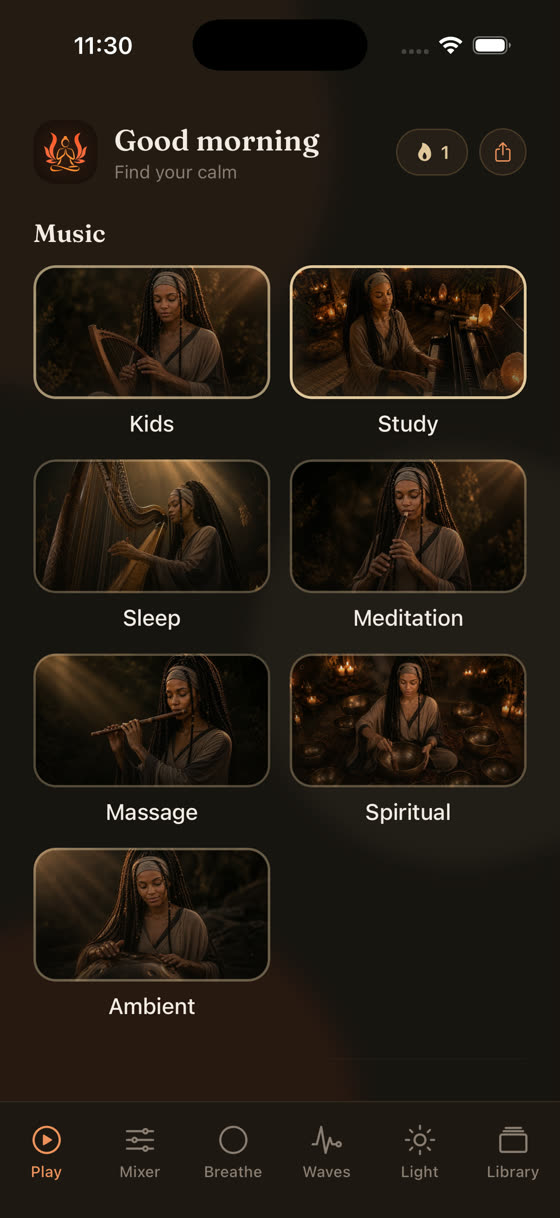
Each category in the app opens as its own space rather than one long shuffled list, so handpan tracks sit inside Sleep and Calm rather than getting buried. Set a sleep timer for 45 minutes, download the track for offline listening if you're somewhere with patchy signal, and resist the urge to turn the volume up to catch every overtone. These recordings are mixed to sit quietly in a room, not to be analysed through headphones at full volume.
When a handpan isn't the right choice
It's not universal. If you're doing work that needs sharp, verbal focus, a solo handpan's melodic phrasing can be distracting precisely because it is pleasant and a little unpredictable; a steadier drone or brown noise bed often serves better there. Live, unrecorded handpan can also suffer from buzzing if a tone field has drifted out of tune or the player's nails catch the metal, which is part of why a clean studio recording behaves differently to a street performance you might have heard. And if you associate the sound with a specific memory or genre you don't enjoy, no amount of slow tempo will override that. Taste still matters more than physics.
The two-minute version to try now
Dim the lights, pick a single handpan track in a minor scale, and sit with just that for two minutes with your eyes closed before adding anything else.
If you want a visual cue to slow your breathing alongside it, the light screen gives you something to follow rather than watching a clock. After that, decide whether you want it alone or want to build it into a fuller mix with rain or a low drone, which is where the rest of the library and the whole point of My Zen Zone comes in, and where you can get the app via this page if you want to try it tonight.
Common questions
Is a handpan the same as a hang drum?
Hang drum refers specifically to the original instrument made by PANArt in Switzerland starting in 2000. Handpan is the broader term for the whole family of instruments other makers now build in the same style. People use the names interchangeably, but strictly, hang is one brand's product and handpan is the general category.
Why do handpan recordings sometimes sound out of tune?
Steel detunes slightly with temperature, humidity and age, and a tone field can drift if it's been struck hard for years. A well-maintained, professionally tuned handpan stays close to true pitch, but cheaper instruments or ones left in a hot car can genuinely go flat on certain notes, which is audible even to non-musicians.
Can a handpan be played fast, or is it always slow and meditative?
It can be played very fast with complex polyrhythms, and plenty of street performers do exactly that. The slow, spacious style most people associate with relaxation is a choice, not a limitation of the instrument. We lean on slow playing because it suits sleep and calm listening, not because the handpan can't do more.
What's the difference between a handpan and a steel tongue drum?
A steel tongue drum is cut from a single sheet with tongue-shaped slits creating the notes, usually played with mallets, and tends to sound more woody and percussive. A handpan is two hammered half-shells glued together, played by hand, with a longer, more bell-like sustain. They're often confused online because both are round and steel.
Does listening to handpan music actually help you sleep?
There's no solid clinical research specifically on handpan and sleep. What we can say is that its slow tempo, lack of lyrics, and long note decay share qualities with other music people commonly find calming. Treat it as one tool worth trying alongside a consistent wind-down routine, not a guaranteed fix.