The best meditation music sits around 50 to 70 beats per minute, avoids any melody you'd feel tempted to hum, and holds roughly the same volume and texture from the first second to the last. That's the short version. The longer, more useful answer is that it depends on what kind of meditation you're doing and what your mind tends to do when it's left alone with sound — which most articles on this topic skip entirely.
Why tempo matters more than genre
People ask for "calm music" or "peaceful music" as if that's a genre. It isn't. What actually changes how a piece of music affects a meditating body is its tempo relative to a resting heart rate, which for most adults sits somewhere between 60 and 80 beats per minute. Music at 50-70 bpm doesn't force your heart to match it — the old claims about strict entrainment are weaker than they're usually presented — but it does remove a reason for your nervous system to stay alert. Fast tempo signals effort. Slow tempo signals nothing is required of you right now. That's the whole job.
This is why a lot of ambient or lo-fi playlists labelled "meditation" don't actually work for sitting practice, even though they're pleasant. They're often closer to 80-90 bpm with a steady beat underneath, which is fine for studying but keeps just enough forward motion that your attention tracks it instead of settling.
What instruments actually help, and which ones fight you
Sustained tones beat plucked or struck ones. A bowed string, a soft pad, a drone, a held piano chord with the sustain pedal down — these give your attention something to rest on without giving it anything to follow. Compare that to a guitar line or a melodic flute part, which naturally makes your brain want to predict where the next note is going. That's not relaxing, it's just quiet entertainment, and there's a real difference between the two for meditation purposes.
Piano is the one people get wrong most often. A piano piece with a clear tune, even a slow and pretty one, pulls you into following a story. A piano piece built from single sustained notes or slow, unresolving chords does the opposite — it gives you texture without narrative. If you've ever meditated to a piece and caught yourself anticipating the next phrase, that's the melody doing its job as music, which is also the wrong job for this purpose.
The mistake most "relaxing" music makes
Commercial relaxation music is often composed like film score: it builds, it swells, it has a dynamic arc because that's what makes music interesting to listen to actively. For meditation, an arc is a liability. A swell fifteen minutes in will pull your attention back to the room right when you'd ideally stopped noticing the music at all. The tracks that work best for sitting practice are almost boringly flat in structure — not lifeless, but even, so the music can sit in the background of awareness rather than asking for a place in the foreground.
This is also why so many people meditate better to the same two or three tracks than to a constantly shuffling playlist. Familiarity lowers the chance of being surprised by a new sound.
Silence, texture, and why nature sounds aren't a shortcut
Some people do better with no music at all, just a single layer of rain or ocean or low wind. Broadband natural sound like this works for a different reason than composed music does — it masks sudden noises from outside (a door, traffic, someone's voice in the next room) so your attention isn't repeatedly pulled away by small surprises. The downside of a single nature sound on its own is that it can get monotonous or, oddly, more noticeable over a twenty-minute sit than a layered mix would be.
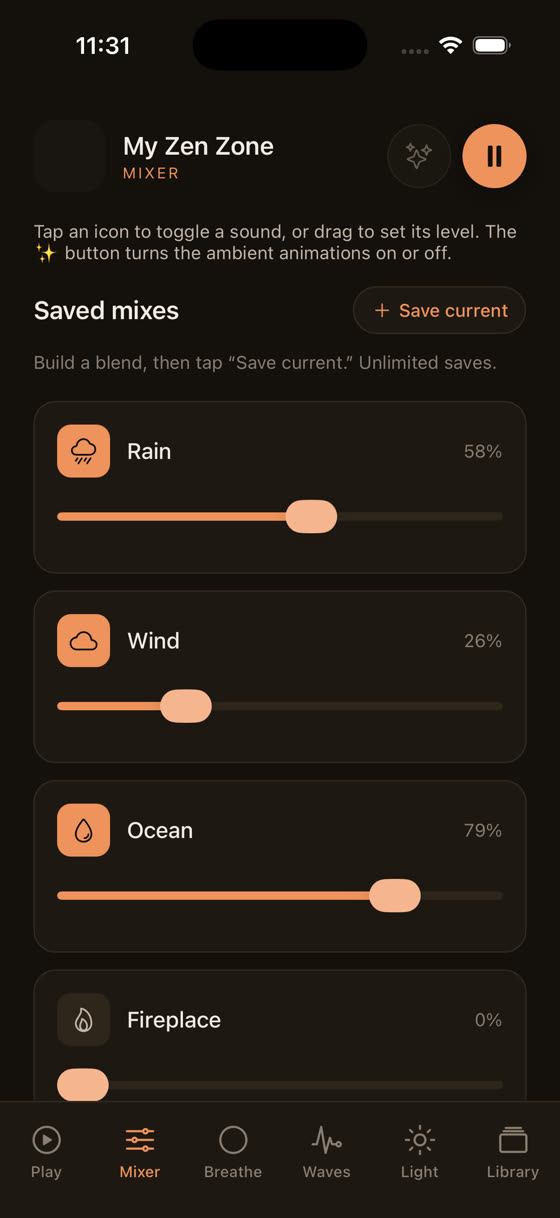
This is one of the places where having separate control over each sound actually changes the experience rather than just being a nice feature. Being able to put a thin layer of rain under a very quiet drone, with each at its own level, gives you masking and texture without either one being loud enough to become the thing you're listening to.
Guided meditation and music shouldn't have to compete
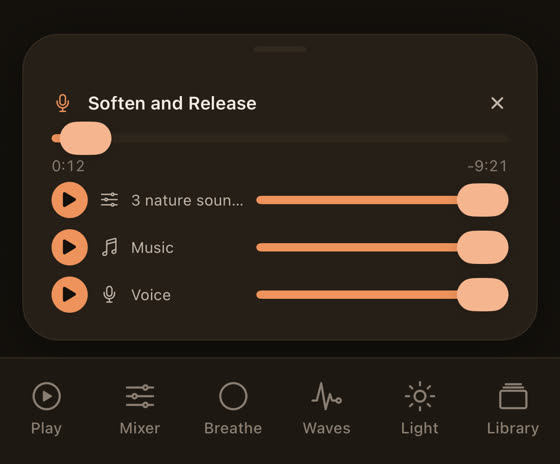
A lot of guided meditation apps make you choose: play a spoken session, or play music, because the software can only run one at a time. The voice either comes over silence, which feels stark, or it's dropped onto a pre-mixed music bed you can't adjust, which means if the music is too loud you lose words, and if the voice is too loud the music stops doing anything useful at all.
Voice, music, and background nature sound are three separate layers with their own volume, so a guided breathing session can sit quietly under a voice you can actually hear clearly, rather than one fighting the other for space. If you've only used apps where the music stops the moment someone starts talking, it's worth hearing what it sounds like when it doesn't.
Matching the music to the kind of meditation you're doing
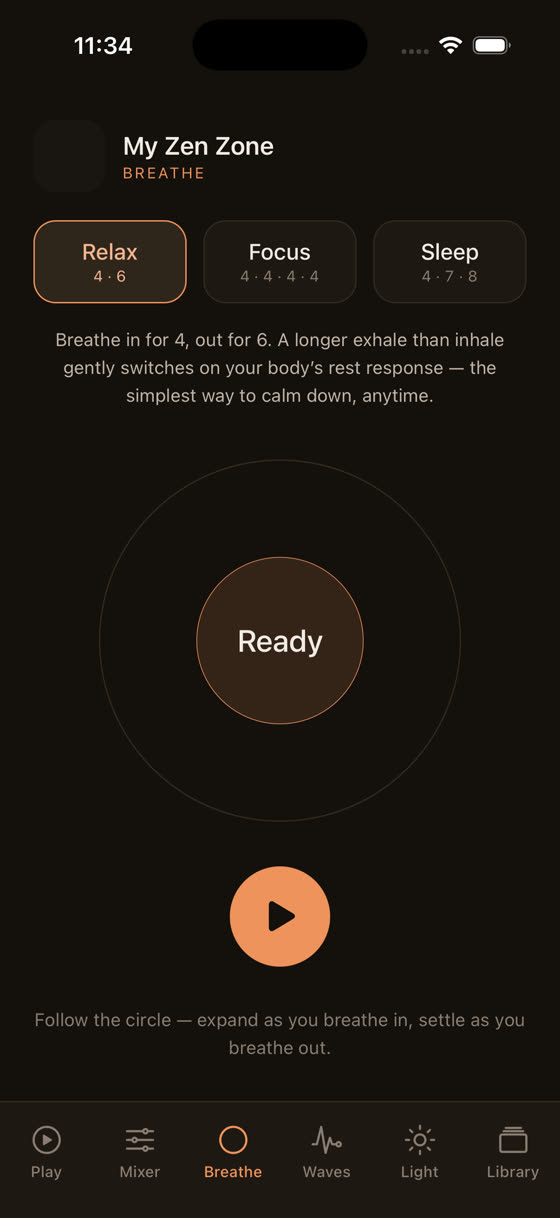
Breath-focused sitting practice and a body scan want different things from music. For breath work, where attention is on a short repeating cycle, even a very sparse drone can be enough, and some people prefer near-silence with just a visual pacing cue. A breathing screen with a 4-6 pattern on the display does more work there than music does, because the eyes and the breath are doing the pacing together.
A body scan or a longer open-awareness sit, where you're moving attention around for 15-30 minutes, benefits more from a slowly shifting texture, something with enough quiet movement that your mind has a reason to stay loosely engaged with the sound rather than drifting into planning tomorrow. Walking meditation is its own case again — most people do better with nothing in their ears at all, or at most a single very quiet ambient layer, since footsteps and breath are already providing the rhythm.
Time of day changes what you need
Meditation music for a 7am sit and meditation music for winding down before bed aren't the same thing, even if both are slow and quiet. Morning sits can handle a touch more presence in the sound, something with a faint sense of openness or brightness, because the goal is steady, alert calm rather than drowsiness. Evening sits lean further toward the kind of music that's one step from sleep music — which is a real and useful overlap, and if that's specifically your goal at night rather than daytime practice, it's worth reading what actually works for sleep rather than treating the two as identical.
There's a similar but opposite distinction with focus music, which deliberately keeps a bit more rhythmic structure to support sustained attention on a task — closer to 80-110 bpm, often with repetitive patterns. If you're trying to concentrate rather than meditate, the advice is genuinely different, and music for focus and study covers that case specifically.
Tools worth trying beyond plain music
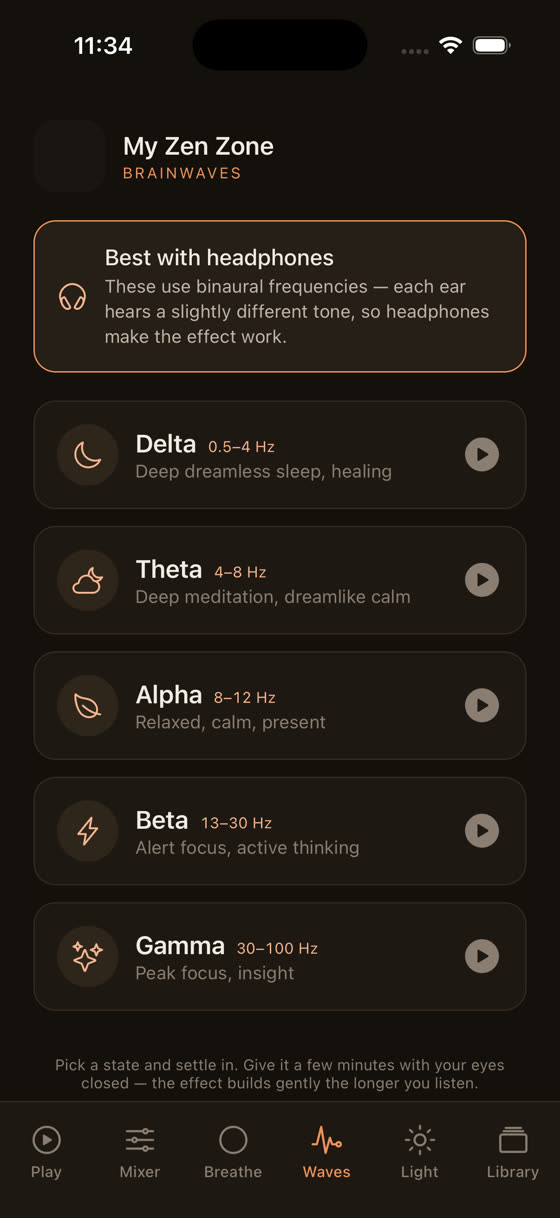
Binaural and isochronic tones get presented online with more certainty than the evidence actually supports — treat claims about specific brainwave states with some scepticism, since the research is mixed and much thinner than the marketing around it suggests. That said, a lot of people find the tones themselves pleasant to sit with, independent of any claimed effect, simply as another texture alongside or instead of music.
The same goes for a simple light screen to look at while winding down before a sit or before sleep — not a scientific tool, just a steady, low-stimulation visual that gives restless eyes somewhere to land.
Building this into an actual habit
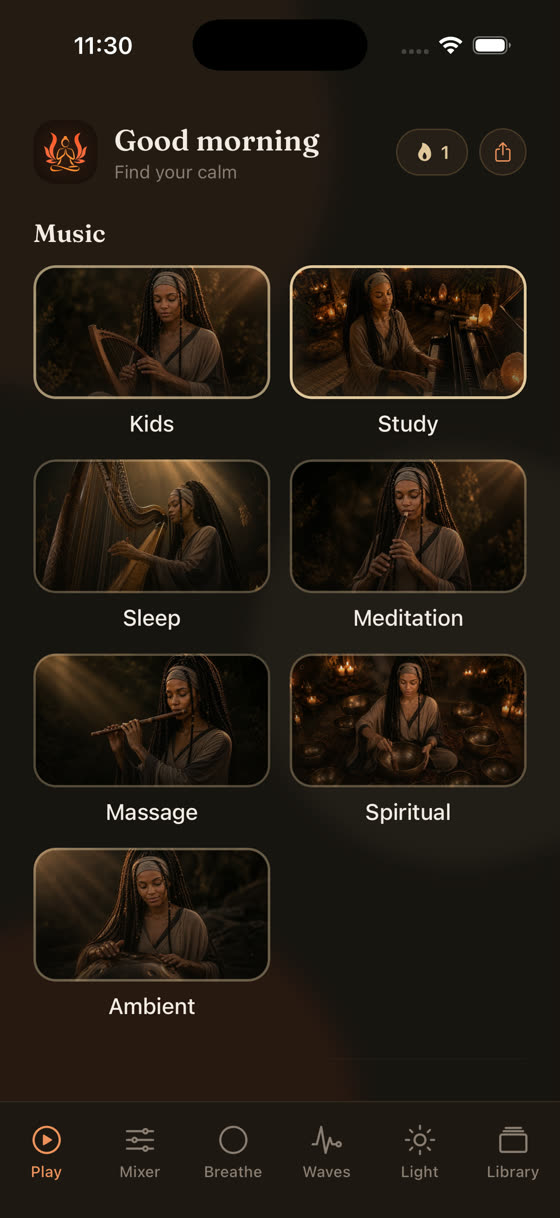
The single most practical thing you can do is stop reshuffling your meditation music every week. Pick two or three pieces that fit the kind of practice you do most, let them become familiar, and use that familiarity as part of the signal to your body that it's time to settle. New composed tracks are added to the library every two weeks here, which is useful for sleep and for general listening, but for meditation specifically, repetition is doing you a favour rather than costing you anything. You can download tracks for offline use so a patchy connection on a quiet retreat or early flight doesn't interrupt a sit, and the whole library, including every category, is available on phone or in a browser with a subscription.
Common questions
Is it better to meditate in silence or with music?
Neither is objectively correct. Silence suits people who get distracted by any sound; music or a steady nature layer suits people who find true silence makes small noises (traffic, a creaking floor) more jarring, not less. Try both for a week each and notice which one your mind settles into faster — that's a better test than any general rule.
Should meditation music have vocals or singing?
Generally no, even wordless vocals. The human voice is the sound your brain is most wired to interpret and track, so even a soft, melody-free vocal tends to pull attention toward it rather than letting it fade into the background, which works against most sitting practice.
Do binaural beats actually help with meditation?
The evidence is thin and mixed, so be wary of confident claims about specific brainwave states. Some people find the tones pleasant and calming as a simple texture, independent of any claimed neurological effect, and that's a reasonable way to use them: as one option to try, not a guaranteed tool.
How long should a meditation track be?
Match it to your sit, not the other way round. A 10-minute flat, non-building track works fine for a 10-minute sit; using a 40-minute piece and stopping it halfway can feel abrupt. A library with varied lengths, or a mixer you can fade out manually, solves this better than one long looping playlist.
What's the difference between meditation music and sleep music?
A lot of overlap, but sleep music tends to be even slower, lower in pitch, and designed to gradually disappear as you drift off, often alongside a sleep timer. Meditation music is built to be listened to with some awareness for a fixed, shorter period while you're sitting upright and present.