Most massage music sits between 50 and 70 beats per minute, has no lyrics, and leans on a handful of instruments: piano, string pads, soft synths, sometimes a singing bowl or two. There's usually a layer of room tone or nature sound underneath, kept low enough that you stop noticing it as music and start hearing it as atmosphere. That's the short answer. The longer answer is about why those choices work on a body that's lying face-down on a table trying to let go.
The tempo isn't arbitrary
A resting heart rate for most adults sits somewhere around 60 to 80 beats per minute. Music at 50-70 bpm doesn't force your heart to slow down, but it removes a pace-setter that would otherwise nudge you the other way. Pop songs run 100-130 bpm because they're built for movement, for kitchens and gyms and cars. Put that tempo under a massage and the therapist's hands are working against the music instead of with it. Good massage music sits at or just under resting pace so there's nothing in the room asking your body to speed up.
This is the same logic behind a lot of what gets used for winding down at night, which is why massage playlists and sleep playlists overlap more than people expect. If you want the fuller version of that argument, we've written about it at best music for sleep.
Why lyrics almost never show up
Words pull on the part of the brain that processes language, even when you're not trying to listen. That's fine at a desk, and it's actually useful for some focus work, which is a different conversation covered in music for focus and study. But on a massage table the goal is closer to the opposite: less parsing, less tracking, less anticipating what comes next. A voice in the room, even a beautiful one, keeps a sliver of attention on standby. Instrumental music lets that sliver switch off.
The instruments that keep showing up
Walk into ten different spas and you'll hear variations on the same small set of sounds:
- Piano, usually played sparsely, with long gaps between phrases rather than a constant stream of notes.
- String pads — not a violin playing a melody, but a held, slowly shifting chord that sits under everything else.
- Soft synthesizer textures, often with no clear attack, so a note seems to arrive rather than strike.
- Singing bowls or bells, used sparingly, more as punctuation than melody.
- Water, rain, or wind, layered quietly under the instrumentation rather than as the whole track.
What all of these share is a lack of hard edges. A plucked guitar string or a snare hit has a sharp onset that your ear locks onto. Massage music tends to fade in and out instead, so there's nothing for your attention to grab and follow.
Where most massage playlists go wrong
Two problems come up constantly, and neither gets discussed much. The first is repetition: a 45-minute massage often runs on a 20-minute playlist on loop, and by the second pass your brain starts recognising the pattern, which is exactly the opposite of what you want during a treatment meant to quiet pattern-recognition. The second is abrupt transitions — streaming playlists jump from one track to the next with a beat drop or a tempo change that yanks you back into alertness right when the therapist has finally got your shoulders to drop. A track that ends cold and starts loud undoes two minutes of work in about two seconds.
This is part of why we release new material every two weeks rather than relying on a fixed set of tracks that a listener eventually memorises. It also means the person using the app for a home massage or a solo wind-down has more than enough length and variety to avoid ever noticing a loop.
Layering matters more than the track itself
Professional spas rarely play one sound source. They blend a music bed with something environmental — rain, a stream, distant birds — because the combination masks the small noises a quiet room can't hide: a door somewhere, an air conditioner cycling, another therapist's footsteps. You can build the same thing at home instead of hoping a single streamed track does all the work.
That's what our mixer is for: three nature layers, each with its own level, sitting under whichever music track you've chosen. Turn the rain up and the music down for a deep-tissue session, or the other way around for something lighter. It's the one thing a fixed playlist can't do — you're not picking a track, you're building a room.
Matching the music to the stage of the massage
Therapists who think about this tend to shift the mood across the session rather than picking one track and leaving it. The first five minutes, while a client is still settling and the therapist is doing lighter effleurage strokes, often calls for something a touch more present — a piano phrase you can actually follow. Once the work gets deeper, into forearms and stretching, the music usually thins out, becomes closer to a pad than a melody, because a client under real pressure doesn't want anything competing for attention. The final stretch, as the session winds down, sometimes drops the music almost entirely in favour of the layered nature sound alone.
You don't need a therapist in the room to use this idea. If you're doing a self-massage, a foam-rolling session, or just trying to come down from a stressful afternoon, treat it as three short movements rather than one static playlist: something with a little more shape at the start, something flatter and lower in the middle, mostly texture at the end.
Bringing this home without a spa membership
You don't need a treatment room to use any of this. A home massage, a stretching routine, or even just lying on the floor for fifteen minutes after a long day benefits from the same three ingredients: a slow instrumental bed, a low nature layer, and no surprises in the transitions.
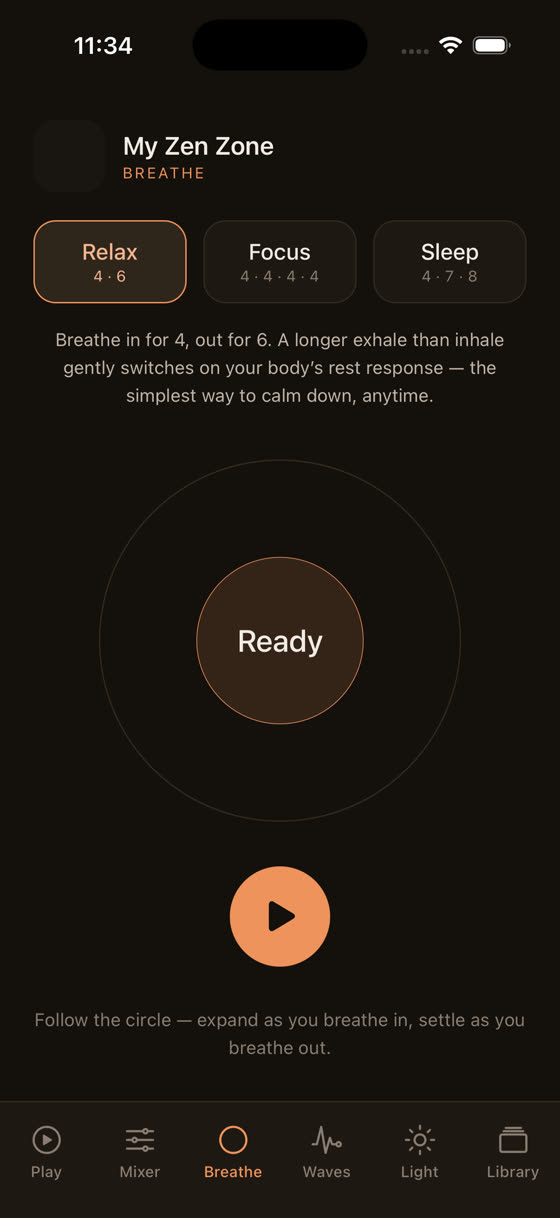
Pair the music with something for the breath and the effect compounds — the app's breathing screen runs a 4-6 pattern, four counts in and six out, which is roughly the ratio massage therapists ask clients to aim for anyway when they say