The short answer
Most massage therapists reach for instrumental music with a steady tempo somewhere between 60 and 80 beats per minute, no lyrics, no drum kit, and very few sudden changes in volume or key. Think solo piano, ambient pads, soft strings, or a single sustained instrument layered with something textural underneath, like rain or a low drone. The goal isn't a genre. It's a shape: smooth, predictable, and quiet enough that it never competes with the therapist's voice or the client's breathing.
That's the practical answer. The more interesting part is why those specific choices work, because most "relaxing spa music" playlists get the details wrong even when they sound fine on the surface.
Why tempo is the first decision, not the last
A resting heart rate for most adults sits somewhere around 60 to 80 beats per minute. Music at or just below that range doesn't force the body to slow down, but it stops giving it a reason to speed up. Fast, rhythmic music, even quiet fast music, tends to nudge heart rate and breathing to match it. This is the same logic behind a lot of music chosen for sleep: the track itself needs to behave like the state you're trying to reach, not just sound pleasant in the abstract.
Therapists who've worked with the same clients for years will often say they can tell within the first five minutes whether the music is working against them. A track that builds to a chorus, or has a rhythmic hook that pulls attention, will pull a client's focus right off the table and into their head. That's the opposite of the job.
Why lyrics are almost always cut first
Words activate language processing even at low volume and even when someone isn't actively listening. That's a genuine mechanism, not a wellness myth: the brain parses speech automatically, which is exactly the kind of low-level mental activity a massage is trying to switch off. Instrumental music removes that tug entirely. This is a big part of why so much of what gets labelled "spa music" or "massage music" is wordless, even when the therapist personally likes songs with lyrics on their own time.
It's also why a lot of ambient or meditation music leans on texture instead of melody: a hum, a held chord, a slow arpeggio. There's something to listen to without anything demanding to be understood.
The instruments that show up again and again
Across most massage and bodywork playlists, a short list of instruments does almost all the work:
- Piano, usually played sparsely, with long gaps between notes rather than a constant stream of them.
- Strings, often a single cello or a small ensemble, used for sustained tones rather than melody.
- Soft synth pads, which can hold a chord for a very long time without drawing attention to themselves.
- Handpan or singing bowl tones, used sparingly as texture rather than rhythm.
- Nature sound beds such as rain, water, or wind, layered underneath rather than used alone.
That last point matters more than people think. Nature sound on its own, for a full hour, can start to feel thin or repetitive. Most therapists who use it well treat it as a layer, not the whole track.
What most generic playlists get wrong
The biggest problem with a lot of free streaming playlists marketed at massage and spa use is variety for its own sake. A 90-minute massage played against a shuffled playlist means tempo, mood, and instrumentation can shift every three or four minutes. Each shift is small, but they add up, and a client's nervous system notices even if their conscious mind doesn't. The session ends up sounding like background music rather than feeling like a continuous, held space.
The second problem is loudness consistency. Streaming playlists are mastered by different people for different purposes, so one track peaks quietly and the next comes in noticeably louder. In a massage room, where the music is often sitting at a genuinely low volume, that kind of jump is jarring in a way it wouldn't be in a car or on headphones.
The volume problem nobody mentions
A detail that rarely makes it into articles on this: most therapists aren't choosing between types of sound, they're balancing several at once. A long piano note, a thin layer of rain, maybe something close to white noise to cover hallway traffic or a creaky massage table. Getting those three elements to sit together, each at the right level, is harder than picking a genre.
This is the actual reason we built the mixer the way we did. Instead of one fixed track, you set independent levels for music and nature sound and let them sit together the way a therapist would balance them in a real room.
Watching those sliders move live is a faster way to understand the idea than reading about it: rain drops to a whisper, the piano comes forward, nothing clips or jumps.
Matching the session length to the appointment
A standard massage runs 50 to 90 minutes. Most commercial playlists aren't built with that in mind, so therapists end up looping a shorter set or manually queuing tracks between clients, which is its own kind of distraction. A library built in longer, continuous pieces, or one with a reliable way to extend a set without a jarring restart, solves a problem therapists deal with every single day and rarely mention out loud.
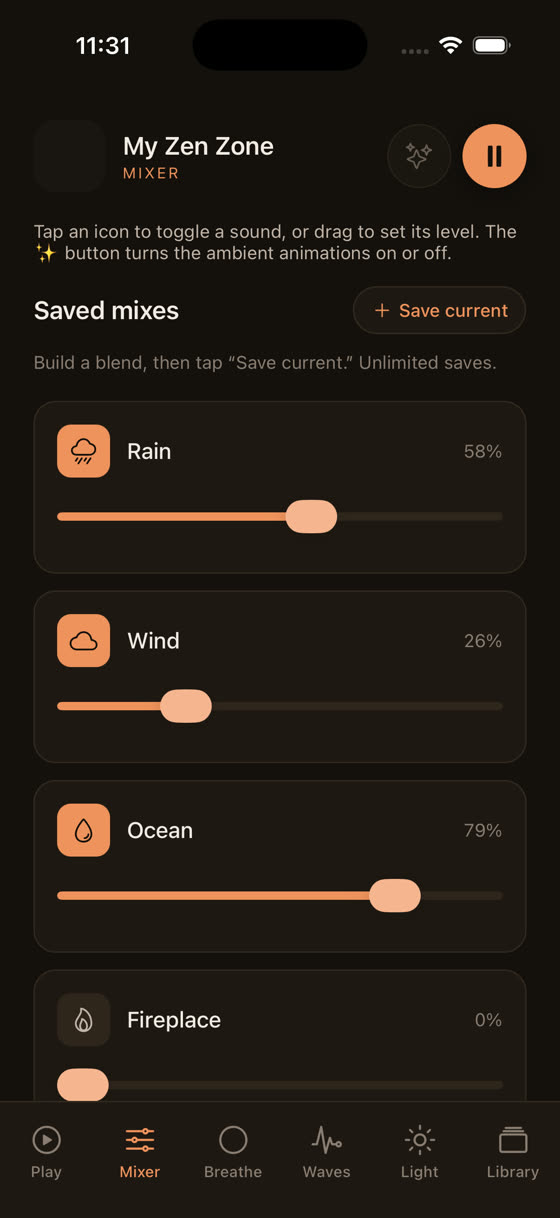
Setting a level for music and a separate level for a nature layer before the client even lies down means there's nothing to adjust mid-session, which matters when your hands are full of oil and someone is already starting to relax.
What to use if you're setting this up yourself
If you're a therapist building your own setup, or just want something closer to what's used professionally for a bath, a stretch, or simply winding down after a long day, the same rules apply outside a treatment room. Pick something instrumental, somewhere around 60 to 80 bpm, and resist the urge to shuffle. A library organised by purpose rather than mood word helps here too.
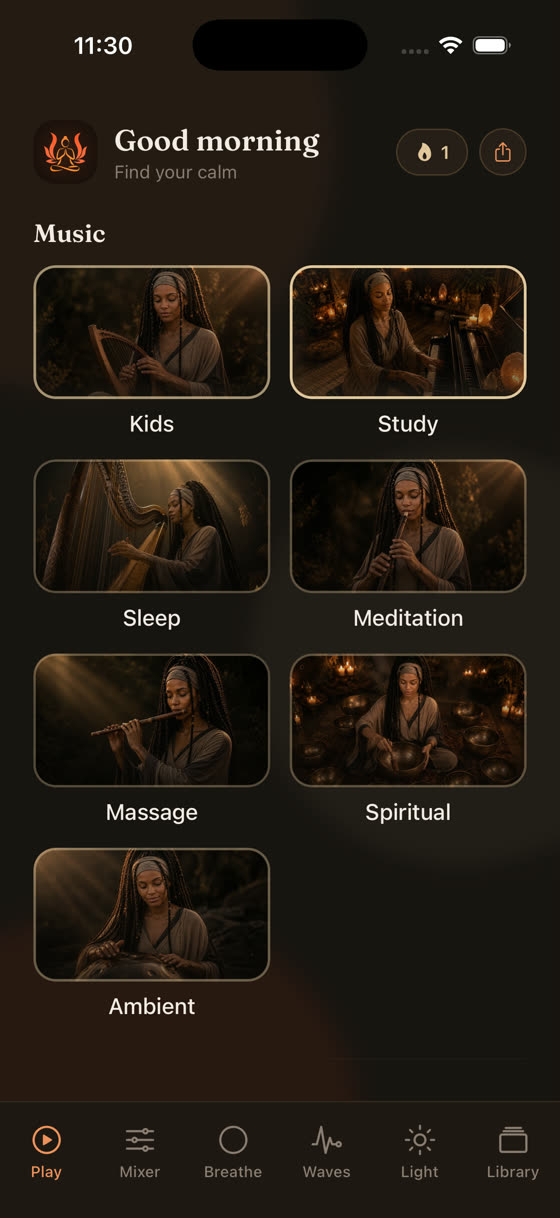
Each category living as its own space, rather than one long undifferentiated list, makes it easier to find music that matches the actual situation: a short reset between clients is a different need from a full evening session, and that's closer to how we think about focus music as well, where the wrong tempo does the opposite of what you want.
Because the whole library is composed in-house by one musician and new tracks are added every two weeks, there's enough depth to build a rotation that doesn't start repeating itself after a month, which matters if you're playing music for the same room, five days a week, for years.
Where to start tonight
If you want to hear the difference a proper mixer and a continuous, purpose-built library make, rather than another shuffled streaming playlist, it's worth trying it directly rather than taking it on description alone. The app is free to download, and the full catalogue, including the fortnightly new releases, is also reachable from the browser if you're setting up music for a treatment room rather than just your own evening.
Common questions
Is white noise or nature sound better for a massage?
Neither on its own is clearly better. Most therapists layer a quiet nature sound, like rain or water, underneath instrumental music rather than using it alone. Used alone for a full hour, nature sound can start to feel thin. As a layer under piano or strings, it fills the gaps without pulling attention.
What BPM is best for relaxation massage music?
Somewhere around 60 to 80 beats per minute, close to a resting heart rate. Music at this pace doesn't push the body to speed up, which is what faster rhythmic tracks tend to do even at low volume. Anything with a strong beat or driving rhythm works against the goal, regardless of genre.
Why do massage therapists avoid songs with lyrics?
Lyrics get processed by the brain's language centres automatically, even at low volume and even if the listener isn't paying close attention. That low-level mental activity works against the aim of a massage, which is to let the mind go quiet. Instrumental music removes that pull entirely.
Can I use the same music for sleep as for massage?
Often yes, since both rely on slow tempo, no lyrics, and few sudden changes. The main difference is session length and how the music is layered; a sleep track usually needs to hold steady for longer and taper off gently, which is covered in more depth in our piece on music for sleep.
How loud should massage music be?
Quiet enough that a normal speaking voice easily sits above it, but present enough to cover room noise like hallway traffic or a creaky table. The exact level matters less than consistency: avoid playlists where one track is mastered louder than the next, which creates a jarring jump mid-session.