The Short Answer
Search Reddit for "best rain noise app" and you'll find the same three or four names traded back and forth, mostly because they were first, not because they're best. The honest answer is that the best rain app for you is one where you can adjust the rain itself, not just press play on someone else's fixed recording. Most of the apps people default to give you a single looping file of rain. That's fine for twenty minutes. It falls apart over a full night or a four-hour work block, because your brain notices the loop point eventually, even at low volume.
What Those Reddit Threads Actually Want
Read past the top comment and the actual requests in those threads are specific: no ads breaking in at 2am, a sound that doesn't have a birdsong sample spliced in every ninety seconds, and something that keeps working with the phone locked and the screen off. Nobody is asking for the fanciest rain. They're asking for rain that behaves. That's a much narrower ask than "best app" and it rules out a lot of the free options that monetise with mid-loop audio ads.
There's also a recurring complaint about rain sounds that are too "clean", meaning too high-frequency, too bright, almost hissy. That's not imagination. A lot of stock rain recordings are mixed with too much top end, which reads as sharp rather than soft. Real rain, especially heavier rain on a roof or against leaves, sits lower and broader across the frequency range, closer to pink noise than white noise. Pink noise has more energy in the lower frequencies, which most people find less fatiguing over long stretches. If a rain track is making you tense rather than calm after twenty minutes, that's often why.
The Problem With Single-File Rain Apps
Here's the mechanism most articles skip. Rain works for sleep and focus because it's a steady masking sound, it covers up sudden noises like a door closing or a car outside so your brain doesn't have to keep checking on them. But a single fixed recording of rain has its own micro-pattern: a slightly heavier gust every forty seconds, a distant rumble that repeats. Loop that for eight hours and your ear starts predicting it. Predictable sound is less effective at masking, because the masking only works while your attention isn't drawn to the sound itself.
The fix isn't a longer recording. It's layering. Two or three rain-adjacent sounds at different volumes, slightly out of sync with each other, stop your brain from finding the seam.
Layer Your Own Rain Storm
This is the actual difference between apps that just play a rain file and apps built for this properly. In My Zen Zone, rain isn't one track, it's one sound you place inside a mixer alongside other nature sounds, each with its own independent level. Put heavy rain at 70%, distant thunder at 20%, and a low wind layer at 15%, and you've built something that doesn't have a single repeating pattern anyone can lock onto. Nudge the thunder down if you're using it at a desk during the day and don't want anything startling; push the rain up and add a fireplace crackle underneath it if you're trying to fall asleep in winter.
That short clip shows the levels actually being moved live, which is a better explanation than a paragraph. Most rain apps don't have this at all. You get one slider, master volume, and that's it.
Rain For Sleep Versus Rain For Focus
These aren't the same use case, even though Reddit threads tend to lump them together. For sleep, you want the rain heavier, lower, closer to a constant rumble, played alongside a sleep timer so it fades out rather than running all night on a phone that's heating up on your nightstand. For focus, during work, you generally want it lighter and want to be able to pull it down fast if you're on a call, without losing your place in a session.
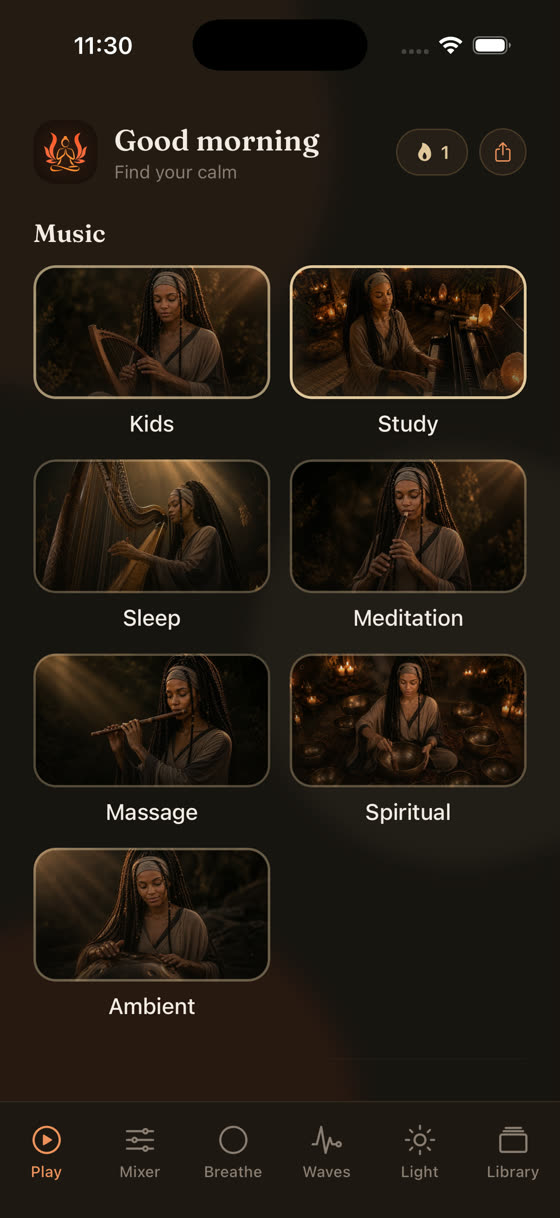
Splitting sleep and focus into separate spaces, rather than one generic "nature sounds" folder, is why we built the home screen the way we did, with each category as its own space rather than one long undifferentiated list. If you're specifically trying to work with sound in the background rather than sleep, it's worth reading our piece on music for focus and study, because rain is only one part of that picture and often works better mixed with something tonal underneath it than alone.
What To Check Before You Download Anything
A few practical filters, based on what actually goes wrong for people:
- Offline playback. If the app needs a live connection to stream rain, it will stutter the moment your signal drops, which is exactly when you're asleep and can't fix it. Downloaded tracks avoid this entirely.
- A real sleep timer, not just an on/off switch. You want it to fade rather than cut off mid-storm.
- No ads mid-loop. Check this specifically, it's the single most common complaint in those Reddit threads.
- Adjustable individual layers, if the app offers more than one sound. A master volume slider over three sounds baked together isn't the same as controlling each one.
Beyond Rain: Building A Full Night Sound
Rain alone gets people most of the way there, but the same layering logic applies to a full wind-down. A guided breathing pattern before sleep, paired underneath with rain at a low level rather than silence, tends to work better than either alone, because the breathing has something ambient to sit inside rather than being the only sound in the room.
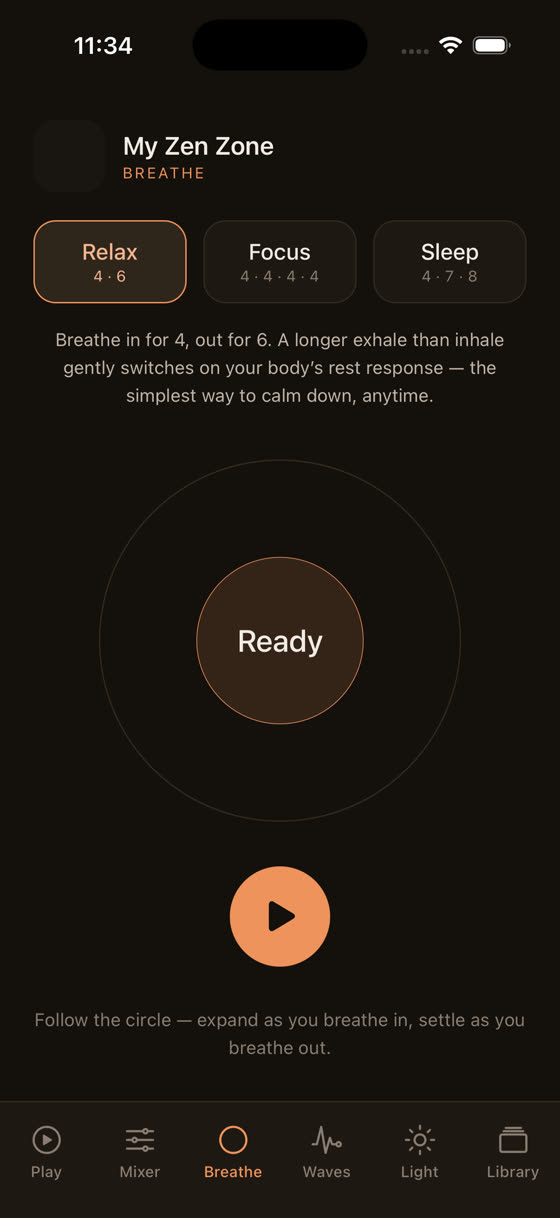
If you haven't tried a paced breathing screen before bed, a 4-6 pattern, four seconds in, six seconds out, run for a few minutes with rain underneath, is worth testing tonight rather than reading about. It's a small thing but it changes how quickly the room feels quiet. For a broader look at what actually helps people fall asleep faster, including where rain sits relative to music, this piece on the best music for sleep goes into more of the evidence, such as it exists, because a lot of the claims made about sleep sound are stronger than the research actually supports.
What To Do Tonight
Skip the ranking debates. Pick one app that lets you layer at least two sounds independently, set rain heavier than you think you want it, add one low secondary layer like distant thunder or a soft drone underneath, and run it with a sleep timer of ninety minutes rather than all night. If you wake at 3am, most apps let you restart the timer without unlocking your phone fully, which matters more than people expect. Try this instead of hunting for a single perfect pre-made rain file. The single file doesn't exist. The mix does.
My Zen Zone runs on iPhone, Android, and a browser once you're subscribed, and new tracks, including new nature layers, get added every two weeks, so the mix you build tonight isn't the last version of it. You can start with the basics here and build from there.
Common questions
Is rain noise actually better than white noise for sleep?
There's no strong evidence either is definitively better; it's largely preference. Rain tends to have more low-frequency content than pure white noise, which some people find gentler over a full night. If white noise feels harsh to you, rain or pink noise is worth trying instead. Neither is proven to improve sleep quality, only to mask disruptive sound.
Why does rain sound different on every app?
Recordings vary by microphone, surface (roof, leaves, pavement), and how much the file has been equalised. Some apps boost high frequencies, which reads as sharper or hissier. If a rain track feels tense rather than calming, try a different recording weighted toward lower frequencies before assuming rain isn't for you.
Should I use rain sounds all night or just to fall asleep?
Most people only need it to fall asleep and during light sleep in the early hours. A sleep timer of 60-90 minutes that fades out works well for most people, rather than running continuously until morning, which can drain your phone battery and heat the device on your nightstand.
Can I mix rain with music instead of other nature sounds?
Yes, and it often works better than rain alone. A slow, low track underneath rain gives your ear something with more structure to settle into, without being distracting. This is exactly what a proper mixer with independent levels is for, rather than picking one or the other.