If you want something to watch tonight, pick a nature documentary you've already seen, keep the brightness low, set a sleep timer for 20-30 minutes, and avoid anything with a plot that resolves. That's the short version. But the honest answer is that watching anything, even something dull, is working against you more than it's helping, and most lists of "best shows to fall asleep to" never explain why.
The direct answer
Repeat-watch content is the least-bad option if you're going to watch something at all. A show you've seen three times, a slow cooking competition, a nature series with long static shots of coral or weather. The common thread isn't genre, it's predictability. Your brain already knows how the scene ends, so there's nothing left to track. New content, even calm-looking new content, asks your brain to keep building a model of what happens next. That modelling is the opposite of what you want at 11pm.
Why screens fight you even when the content is boring
Two things are happening at once, and most articles only mention one of them. The first is light. Screens, even dimmed, emit enough blue-spectrum light at close range to suppress melatonin release in some people, which delays the point where your body feels sleepy. This is real but it's often overstated and it's not the main problem.
The bigger issue is attention. Watching something, even something slow, keeps your visual cortex and prefrontal cortex engaged in a way that pure sound doesn't. Your eyes are still tracking motion, faces, cuts between shots. Your brain is still, quietly, asking "what happens next" even during a documentary about glaciers. That low-level anticipation is a form of arousal, and arousal is what you're trying to wind down from. Audio alone, especially something without lyrics or narrative, gives your brain far less to hold onto, which is exactly the point.
What most "shows to fall asleep to" lists get wrong
They treat "boring" as the whole solution. A nature documentary is calmer than a thriller, sure, but it's still a sequence of edited shots with a narrator building toward something. Even slow TV, the genre built specifically around unedited train journeys and fireplaces, still requires your eyes to stay open and your visual system to stay active to watch it. The lists rarely mention that the actual mechanism working in your favour isn't the content, it's the fact that you eventually stop watching and your eyes close. At that point you're not watching anything anymore. You're listening to a TV you can't see, which is a strange halfway state that most people fall into by accident rather than by design.
If you do watch something tonight, do it like this
- Pick something you've watched before, ideally more than once. No cliffhangers, no plot you're invested in finishing.
- Drop the brightness as low as the screen allows, and if your device has a warm/night mode, use it.
- Set a timer so it switches off after 20-30 minutes rather than auto-playing the next episode. Autoplay is designed to keep you watching, which is the opposite of what you need.
- Put the device further away than arm's reach, so when your eyes close you're not tempted to check it again.
The better trade: close your eyes and listen instead
Here's the thing worth trying tonight instead of your usual show. Skip the screen entirely and put on something built for sound alone: slow instrumental music, rain, or a low drone, somewhere in the 50-70 bpm range, close to a resting heart rate. There's no picture to track, no narrator building toward a point, nothing asking your eyes to stay open. We cover the tempo and instrument choices in more detail in our guide to music for sleep, but the short version is that music without a vocal line and without sudden dynamic shifts gives your brain almost nothing to hold onto, which is exactly what you want at that hour.
Most sleep apps hand you a single fixed track and call it a day. That's fine until the rain loop gets predictable or the music is a touch too quiet under it. We built the mixer so you can layer three sounds at once and set each one's level yourself, rain louder, music lower, a distant thunder barely there.
Watch those three levels move independently and you'll see why a fixed playlist feels thin by comparison. It's the one thing most competing apps genuinely don't offer.
How guided wind-downs fit into this without feeling like a lecture
Some nights you don't want music alone, you want a voice talking you down, a body scan or a slow count of breath. The problem with most guided sleep tracks is that the voice replaces the music entirely, so you get narration, then silence, then more narration, which keeps your attention working to follow the thread. We built guided sessions so the voice plays as its own layer over the music and nature sound, not instead of them, with separate levels for Voice, Music, and nature so you can fade the voice down as you drift and leave the music running underneath.
That's a guided session playing with its own play button per layer, which means you can turn the voice down halfway through without losing the music that was carrying you along in the background.
Building a screen-free wind-down routine
The habit that actually moves the needle isn't the show, it's the twenty minutes before you try to sleep. Dim the lights in the room, not just the screen. If you use a light before bed as part of the ritual, a soft, warm, slowly-shifting light is a better cue to your body that it's time to wind down than a backlit screen ever will be.
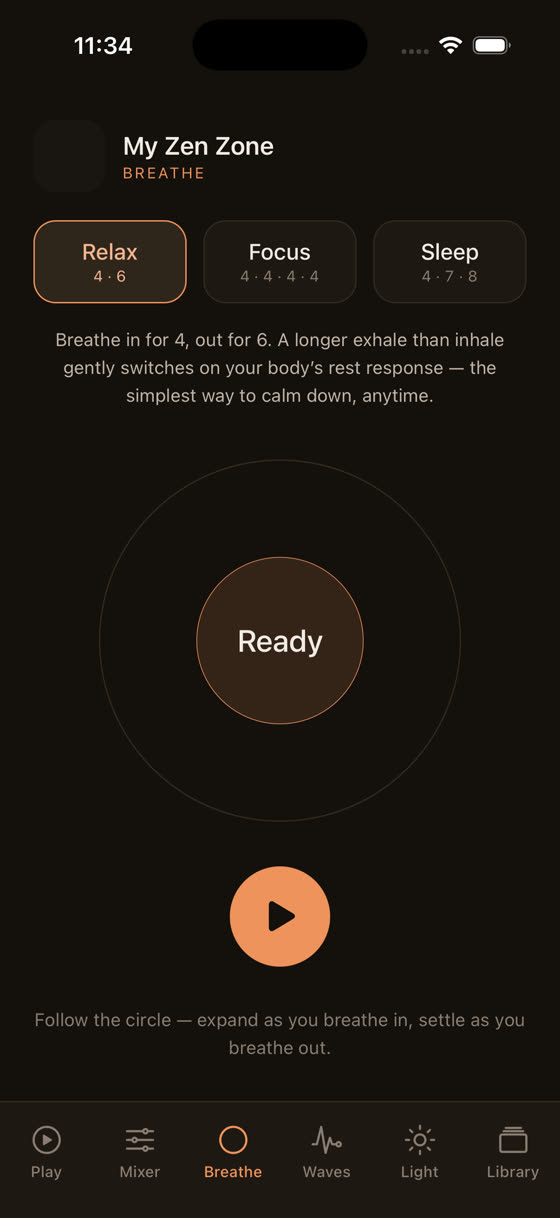
A few slow breaths help too, in for four, hold for a beat, out for six, a pattern sometimes called 4-6 breathing. You don't need an app for that, but having something on screen to pace it without needing to count yourself is one less thing to think about.
Stack those with a sleep timer so the audio switches off on its own and you've replaced